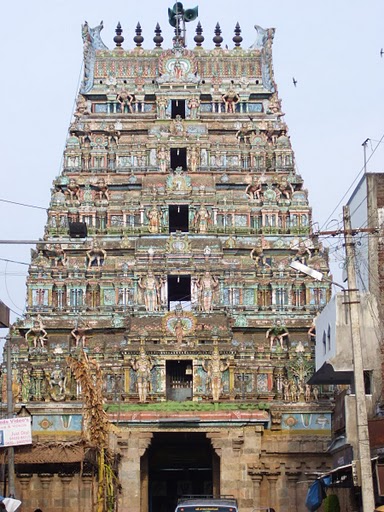
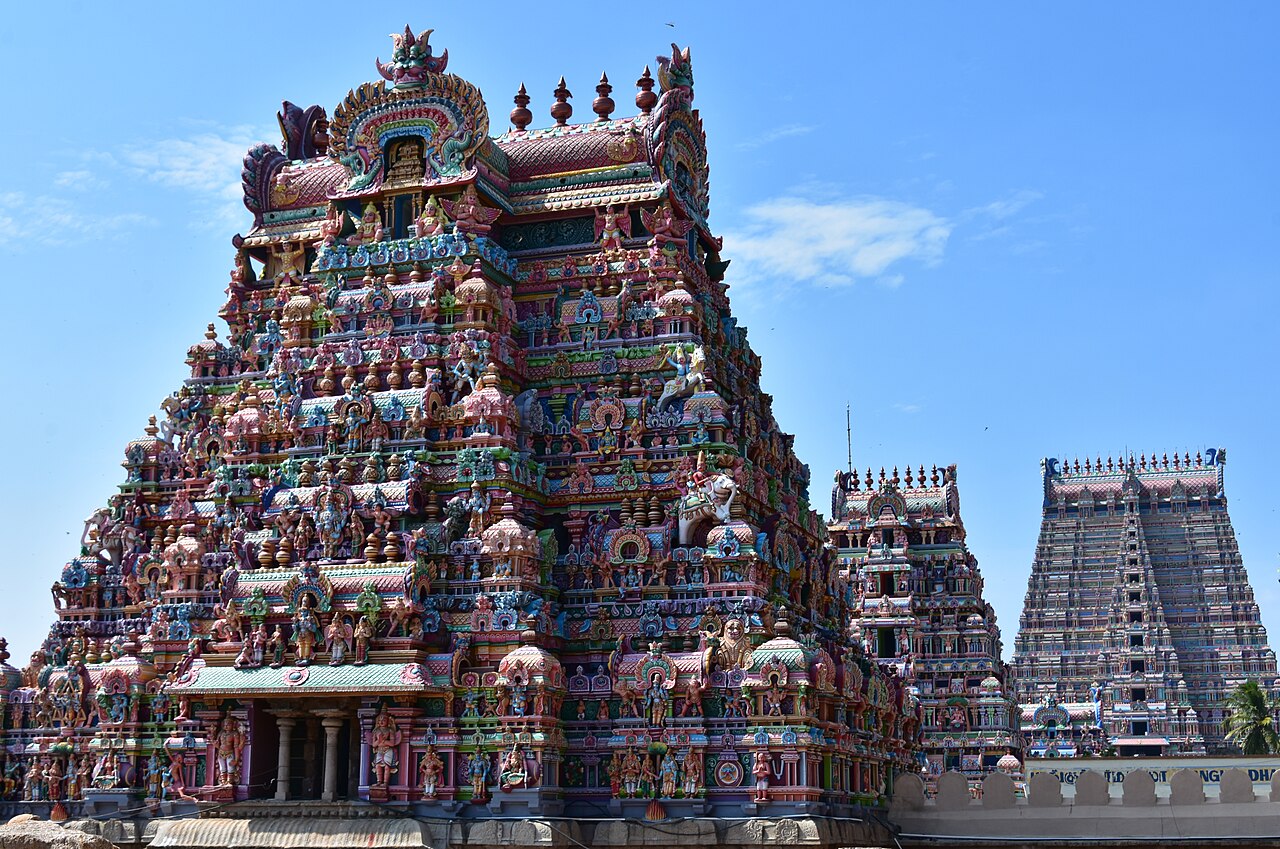
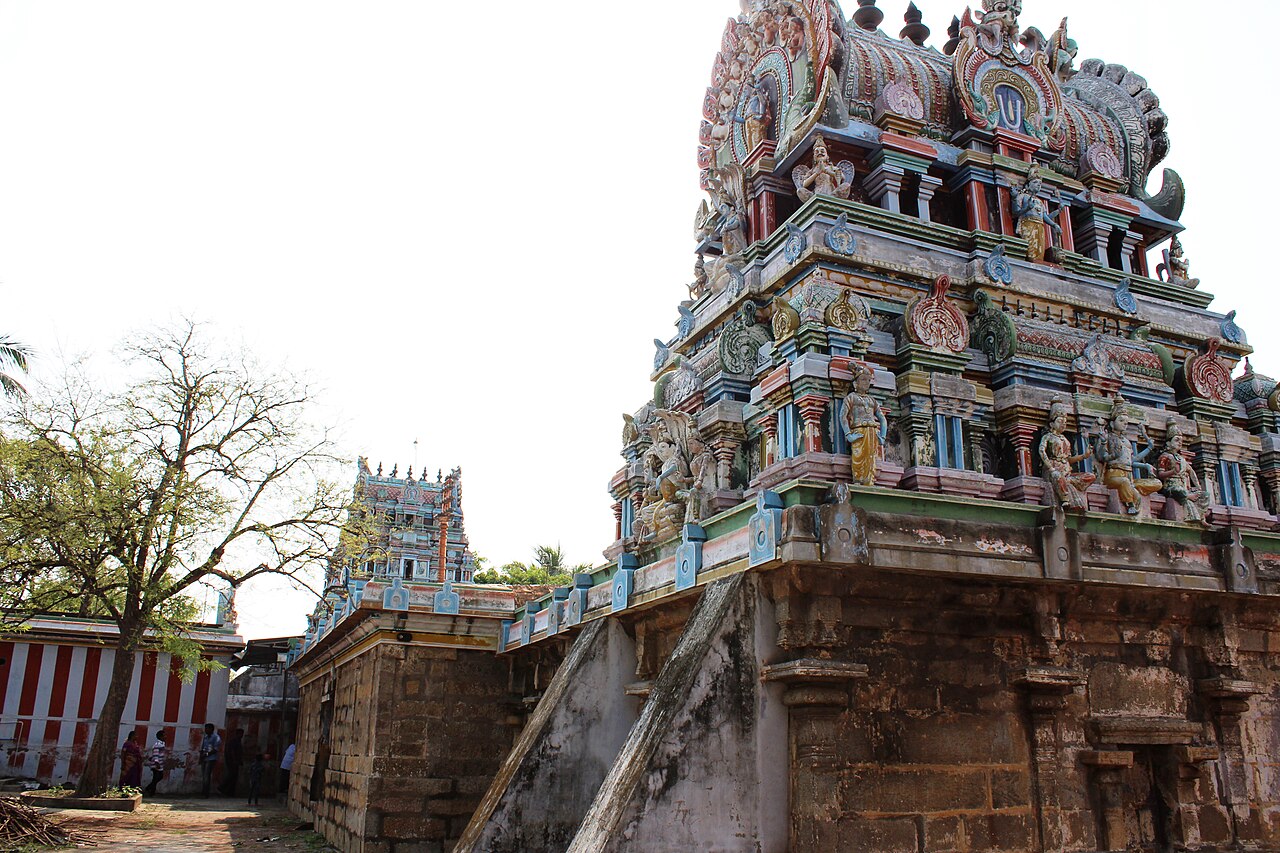
Sarangapani Temple, Kumbakonam
Thirukkudanthai
Adam Jones Adam63 · CC BY-SA 3.0 · source
Largest Vishnu temple in Kumbakonam; ranked among the foremost Vaishnava shrines after Srirangam and Tirupati.
Sthala Purāṇam
Thirukkudanthai, the Sarangapani temple at Kumbakonam, is among the foremost Divya Desams and a Pancharanga Kshetram. Its sthala puranam begins with sage Bhrigu, who, testing the supremacy of the Trimurti, kicked the Lord's chest at Vaikuntha; though Narayana forgave him, Goddess Lakshmi, who resides upon His chest, took offence at the slight and departed to be born on earth. Bhrigu thereafter prayed that Lakshmi be born as his own daughter. Reborn as Hema Rishi (Hemarishi), he performed severe penance on the banks of the Potramarai (golden-lotus) tank. Pleased, the Lord granted the boon, and Lakshmi manifested upon a lotus amid a thousand blossoms in the tank, named Komalavalli for her tender lotus birth. To wed her, the Lord descended from Vaikuntha as Aaravamudhan (insatiable nectar) seated in a great chariot drawn by horses and elephants; residing first at the nearby Someswaran shrine to win her consent, He married her here. The central sanctum is sculpted as that very celestial chariot. The Perumal is Sarangapani, He who bears the Saranga bow in His hand, reclining as Uthana Sayi, and the Thayar is Komalavalli. The towering eleven-tiered rajagopuram and the chariot-shaped vimana mark the shrine, which is glorified by numerous Alvars including Andal, Periyalvar, Tirumalisai Alvar, Nammalvar and Thirumangai Alvar.
Mangalāśāsanam — the Āḻvār pāsurams
The Lord Sarangapani (Aaravamudhan) with Komalavalli of Thirukkudanthai is glorified in 51 pāsurams by:
Thirukkudanthai (Sarangapani temple, Kumbakonam) is the 3rd among the 108 Divya Desams and an 'Ubhaya Pradhana' kshetram where the mula-murti Aravamudhan and the utsava-murti Sarangapani are equally revered. It is one of the most richly sung sacred abodes, glorified by seven Alvars in a total of 51 pasurams. The most celebrated is Nammalvar's 'Aravamudhe' decade (Thiruvaaymozhi 5.8), an outpouring of love in which the Alvar surrenders to the reclining Lord. Tradition links the temple to Nathamuni, who, on hearing the 'Aravamudhe' verses, was inspired to recover and compile the entire Nalayira Divya Prabandham.
ஆராவமுதே அடியேன் உடலம் நின்பால் அன்பாயே நீராய் அலைந்து கரைய உருக்குகின்ற நெடுமாலே! சீரார் செந்நெல் கவரி வீசும் செழுநீர்த் திருக்குடந்தை ஏரார் கோலம் திகழக் கிடந்தாய் கண்டேன் எம்மானே
ArAvamudhE adiyEn udalam ninpAl anbAyE / nIrAy alaindhu karaiya urukkuginRa nedumAlE! / sIrAr senneRkavari vIsum sezhunIrth thirukkudandhai / ErAr kOlam thigazhak kidandhAy kaNdEn emmAnE
O insatiable ambrosia (Aravamudhe)! O great Lord (Nedumal) who melts this servant's very body into water out of love for You! I have seen You, my Lord, reclining in beautiful, resplendent form at fertile, water-rich Thirukkudandhai, where fields of fine red paddy sway and fan You like royal whisks. (Nammalvar's celebrated surrender to Aravamudhan of Thirukkudanthai.)
More verses & references (1)
- Thirukkudanthai (Sarangapani / Aravamudhan) is one of the most extensively sung Divya Desams, glorified by seven Alvars in 51 pasurams. Besides Nammalvar's famous 'Aravamudhe' decade, Thirumangai Alvar, the three earliest 'Mudhal' Alvars (Poigai/here Bhoothath, Pey, Thirumalisai), Periyalvar and Andal all offer mangalasasanam, celebrating the reclining Lord of Kumbakonam. — Thirumangai Alvar, Periya Thirumozhi / Thiruvaaymozhi / Periyalvar Thirumozhi / Nachiyar Thirumozhi (multiple) · source ↗
Tamil text & meaning sourced from divyaprabandham.koyil.org and other Śrī Vaiṣṇava authorities — please cross-check the linked source for the canonical reading.
Read the pāsurams ↗Gallery

Tap an image to view it larger — use ‹ › to browse, ✕ to close. Images via Wikimedia Commons.
Plan your visit
📍 10.96020, 79.38450
Routes, distances, hotels and restaurants open in Google Maps with live data. Build a phased pilgrimage plan →